
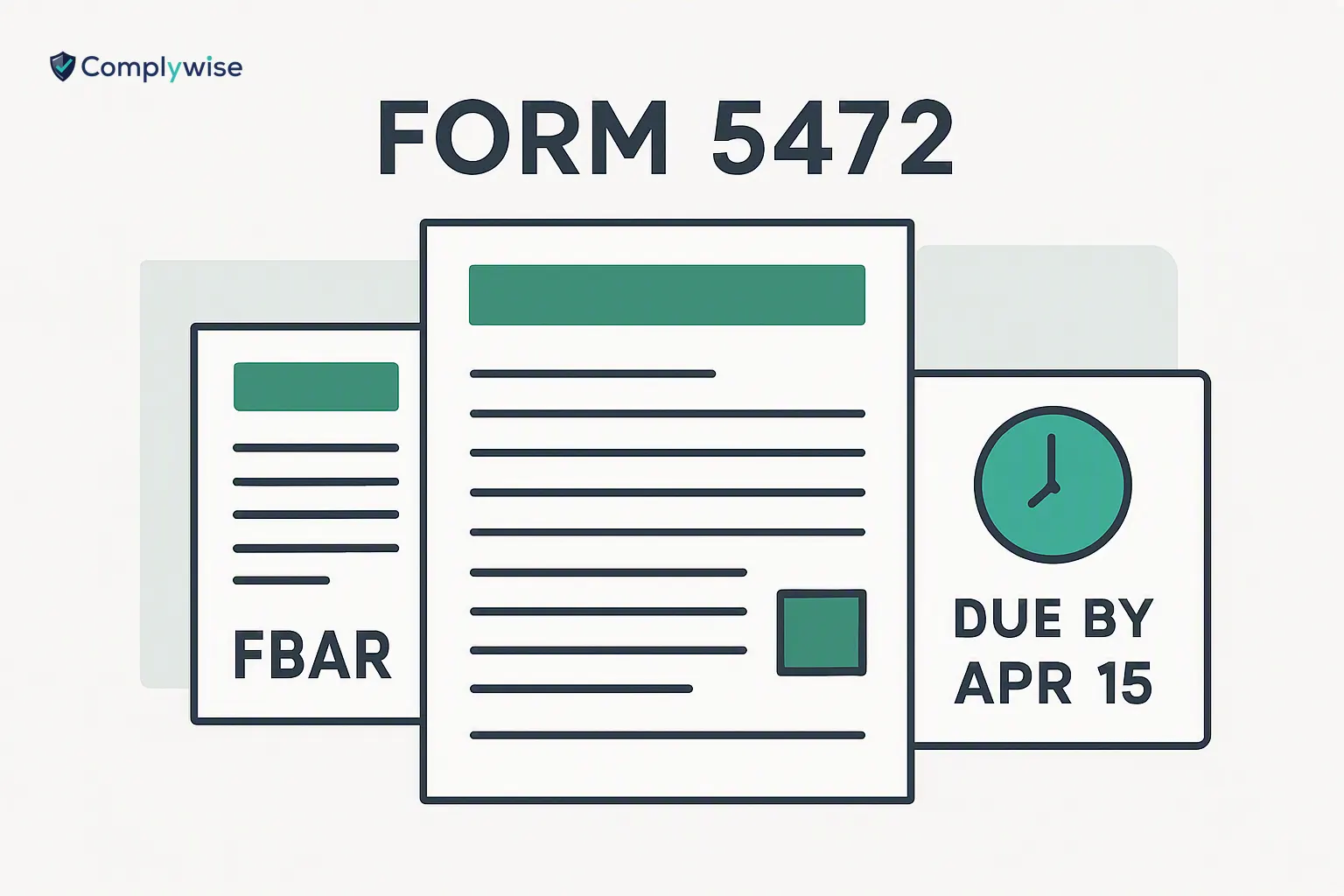
Foreign entrepreneurs who own U.S. LLCs often encounter two distinct reporting worlds: the IRS world of Form 5472, and the FinCEN world of FBAR. These are separate requirements administered by different agencies with different penalties. Confusing them - or missing either - can be costly.
What Is Form 5472?
Form 5472 is an IRS information return filed to report transactions between a U.S. entity and its foreign owners or related foreign parties. It is filed with the IRS as part of the LLC's annual tax compliance, attached to a pro-forma Form 1120. The $25,000 penalty per violation is assessed by the IRS.
What Is FBAR (FinCEN 114)?
FBAR - the Foreign Bank Account Report - is a filing requirement administered by FinCEN (Financial Crimes Enforcement Network), a bureau of the U.S. Treasury. It applies to U.S. persons (including U.S. entities like LLCs) that hold a financial interest in or signature authority over foreign financial accounts with an aggregate value exceeding $10,000 at any point during the calendar year. The FBAR is filed electronically through the BSA E-Filing System by April 15, with an automatic extension to October 15.
Key Differences Between Form 5472 and FBAR
Form 5472 is an IRS form; FBAR is a FinCEN form. Form 5472 is for U.S. entities with foreign owners reporting on related-party transactions; FBAR is for U.S. persons or entities with foreign financial accounts. Form 5472 concerns the relationship between the LLC and its foreign owner; FBAR concerns whether the LLC holds accounts outside the United States. Both can apply simultaneously - a foreign-owned U.S. LLC with a foreign bank account may need to file both.
FBAR Penalties vs. Form 5472 Penalties
FBAR penalties are severe: a non-willful failure to file is $10,000 per violation per year; a willful failure can reach the greater of $100,000 or 50% of the account balance per year, with potential criminal charges. Form 5472 penalties are $25,000 per form per year. These penalties are separate and can both apply. A foreign-owned LLC that fails to file either form could face over $35,000 in penalties for a single tax year.
Frequently Asked Questions
My U.S. LLC only has a U.S. bank account. Do I still need to file FBAR?
FBAR is for foreign financial accounts. If your LLC only has U.S. bank accounts, FBAR likely does not apply. Form 5472 may still apply depending on your ownership structure and transactions.
I am a foreign person who owns a U.S. LLC. Do I personally need to file FBAR?
FBAR applies to 'United States persons,' which includes U.S. citizens, residents, and entities. As a non-resident foreign individual, you generally are not a U.S. person for FBAR purposes. However, the LLC itself - as a U.S. entity - may have FBAR obligations if it holds foreign accounts. Consult a cross-border tax advisor if you have foreign accounts held through the LLC.
Does ComplyWise handle FBAR filing?
ComplyWise specializes in Form 5472 and pro-forma Form 1120 filings for foreign-owned U.S. LLCs. For FBAR requirements, we recommend consulting a qualified cross-border tax advisor, as FBAR is a separate FinCEN obligation.
Official guidance
The IRS and FinCEN pages covering the topics above. They are the authority; this article is not. Rules change — check the current version before you file.