
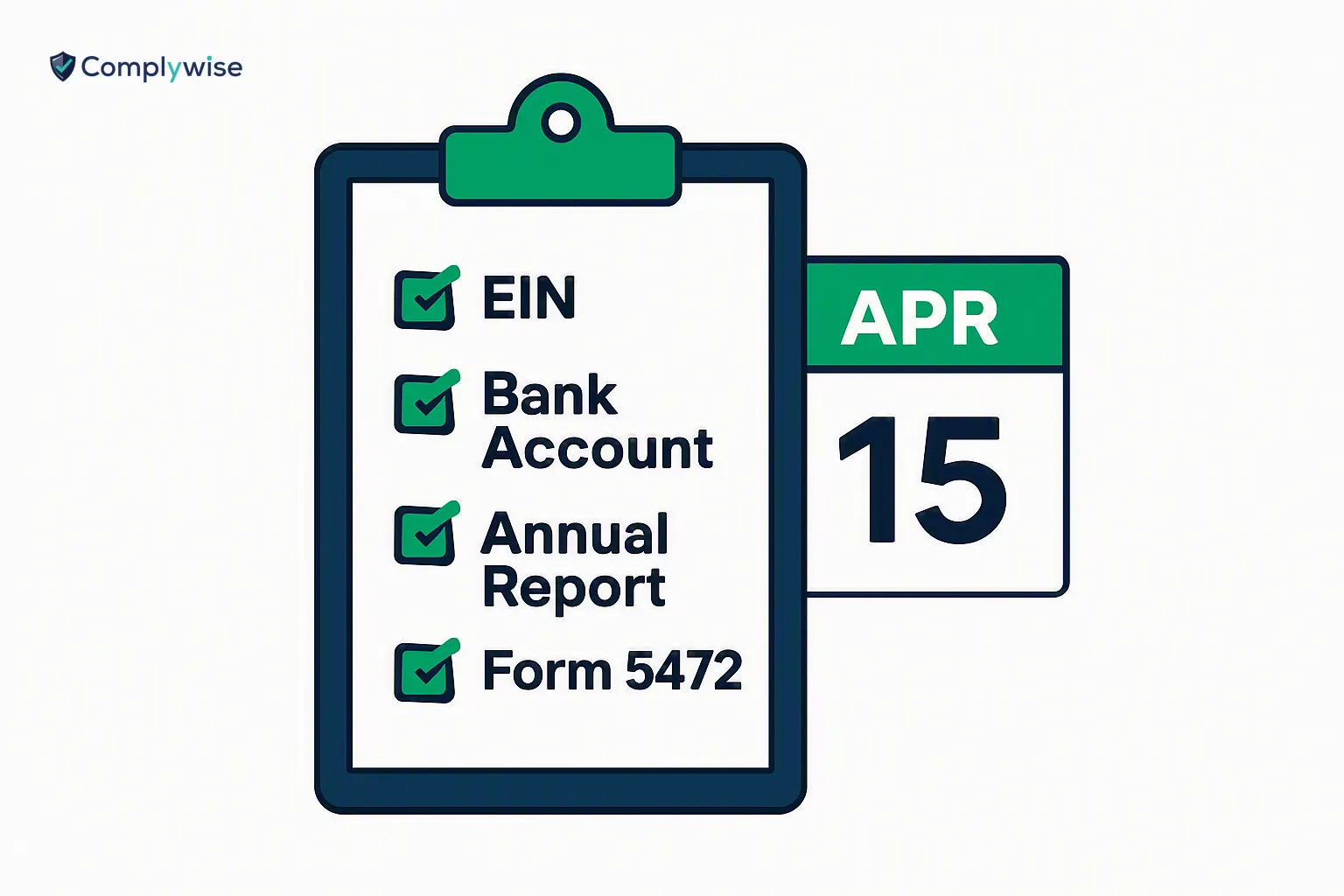
Congratulations — your US LLC is formed. But formation is step one, not the finish line. Most non-US founders find out too late that a US LLC comes with an annual federal filing obligation that has nothing to do with how much money the company made.
Here's the checklist, in order.
1. Get Your EIN (if you don't have one yet)
Your EIN (Employer Identification Number) is what lets you open a bank account, get paid, and file with the IRS. Without a US Social Security Number, you apply directly with the IRS by fax or mail — it typically takes several weeks, so start this early.
2. Open a US Business Bank Account
Most foreign founders use an online-first provider that supports non-resident applicants. You'll need your EIN confirmation letter and formation documents ready.
3. Set (or Renew) Your Registered Agent
Every US LLC needs a registered agent with a physical address in the state of formation. This is usually an annual subscription — don't let it lapse, since it can put your LLC out of good standing.
4. File Your State Annual Report / Franchise Tax
This is separate from your federal obligations below. Delaware, for example, charges an annual franchise tax and requires an annual report; Wyoming has its own annual report fee. Check your specific state's requirement and deadline.
5. File Form 5472 + Pro-Forma Form 1120 — Every Year
This is the filing most new foreign founders don't know exists, and it's the one with the steepest downside.
If your LLC is owned by a non-US person and is a single-member "disregarded entity," and there was any reportable transaction between you and the LLC during the year — funding it, paying an expense on its behalf, even a small transfer — you're required to file Form 5472 together with a pro-forma Form 1120. This applies whether or not the LLC made a profit, and in many cases even if it had no revenue at all.
The IRS penalty for missing or filing this incorrectly is $25,000 per form, per year. There's no revenue threshold that exempts you.
The deadline is the 15th day of the 4th month after your tax year ends — April 15 for calendar-year LLCs, unless you file for an extension.
Start your Form 5472 filing now →
6. Check Your BOI (Beneficial Ownership) Status
This one changes, so it's worth double-checking each year. As of the current FinCEN rule, US-formed LLCs and corporations — including those owned by non-US persons — are exempt from BOI reporting. The obligation now applies only to entities that were formed outside the US and later registered to do business in a US state. If your LLC was formed under US state law, you're currently not required to file a BOI report — but keep your ownership records current in case the rule changes again.
7. Set Up Basic Bookkeeping
Even a simple spreadsheet tracking money in and out of the LLC will save you hours when it's time to prepare your annual filing — and it's the paper trail the IRS expects you to be able to produce if asked.
Frequently Asked Questions
Do I need to file US taxes if my LLC made $0 in revenue?
Possibly yes — filing Form 5472 is a reporting requirement, not a tax on profit. It's triggered by transactions between you and the LLC, not by revenue. Read the full breakdown →
What is Form 5472?
An informational return the IRS requires from foreign-owned US disregarded entities (and 25%+ foreign-owned corporations) to report transactions with related parties, filed together with a pro-forma Form 1120.
What's the penalty for not filing Form 5472?
$25,000 per form, per year, plus an additional $25,000 for every 30 days it remains unfiled after IRS notice.
Do foreign-owned LLCs still need to file a BOI report?
No — not if the LLC was formed under US state law. Only foreign-formed entities registered to do business in the US currently have this obligation.
Official guidance
The IRS and FinCEN pages covering the topics above. They are the authority; this article is not. Rules change — check the current version before you file.